
Around 57,000 households in the ACT have rooftop solar, and across NSW and the rest of Australia the numbers keep climbing.[1] That's a lot of clean energy sitting on rooftops. But here's the thing: only about 15% of those households have added a battery. That gap is closing fast, and the timing matters more than people realise.
Why? Because the way you can use a battery has changed. It’s not just about storing daytime solar for evening use anymore. If you’ve got a compatible battery, a Virtual Power Plant (VPP) can turn it into something that earns for you rather than just saves for you. The choice is yours: run your battery the usual way or put it to work and get paid for it.
Whether you already own a battery or you're weighing one up, here's what you need to know about VPPs and why they’re worth your attention.
Click on a heading below to read more, or scroll down for the full details.
How does a VPP work?What VPP options are available to ActewAGL customers?
How much can you earn from a VPP?
What rebates and incentives are available to purchase a battery?
Where do VPPs fit into Australia's energy future?
Frequently asked questions
How does a VPP actually work?
Key takeaways
-
VPPs connect home batteries into a network that supports the grid and can earn you money in the process.
-
Australian battery owners can receive bill credits or supply charge reductions through VPP programs. Returns vary by program type, battery size and market conditions.[2]
-
The Australian Government's Cheaper Home Batteries Program offers around 30% off battery installation costs.[3]
-
ActewAGL offers VPP options for eligible customers across the ACT and NSW, including the Battery Saver plan and Battery Power Top-Up.
The detail
Australia has among the highest rates of rooftop solar adoption in the world, with more than one in three households now equipped with solar panels.[4] That distributed generation is the foundation VPPs are built on.
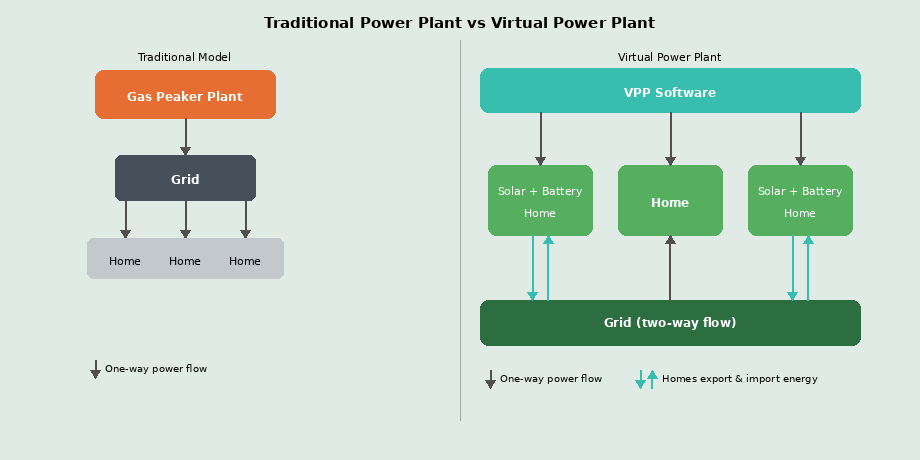
A VPP isn't a physical building. It's hundreds of homes combining their home batteries into a single coordinated resource - a network that can respond to the grid in real time.
Think of it this way. Your home battery stores excess solar energy during the day. Normally, you'd use that stored energy in the evening or overnight. Including your battery in a VPP does the same thing, but it can also respond to signals from the grid when electricity demand spikes. On a scorching Canberra summer afternoon, when everyone's cranking the air conditioning, the grid comes under strain. A VPP can instruct participating batteries to discharge a small amount of energy into the grid at exactly the moment it's needed. Thousands of batteries doing this simultaneously can deliver the same output as a traditional power station.
What's the difference between a VPP and a traditional power plant? No smokestacks, no fuel costs and no single point of failure. It's distributed, it's clean and it sits on your property. Instead of electricity travelling long distances from large, centralised power stations, it’s supplied from where it’s consumed. Customers can actively participate in the energy system, and the grid becomes more flexible, reliable and future‑ready.
How a discharge event actually feels:
Most VPP participants don't notice events happening at all. Your battery discharges a portion of its stored energy within a short window (typically under two hours) and recharges from your solar the next day. With many VPPs, including ActewAGL’s, there’s a protected minimum charge of 20%, so there’s always a reserve for your own use.
What VPP options are available to ActewAGL customers?
ActewAGL offers a couple of options for customers with eligible batteries who want to participate in a VPP.[5]
Battery Saver plan
This is a dedicated energy plan for VPP participants. When you connect your battery and sign up, your daily supply charge is reduced. The VPP participation value is passed through directly as that supply charge reduction. You also receive a feed-in tariff when your home exports energy. It's designed for households looking to get more value from their battery on an ongoing basis.
Battery Power Top-Up
If you'd prefer to stay on your current ActewAGL plan, the Battery Power Top-Up adds a $60 credit to your electricity account each quarter ($240 per year), while you remain connected to the VPP. You keep your existing plan and the credit is added on top.
Eligibility and technical requirements
Eligible battery brands currently include Tesla, SolarEdge/LG Chem, Signergy, AlphaESS and Sungrow. For the current list of compatible models, check the Battery Saver plan page, as the list is updated over time. Other requirements include a continuous internet connection (Wi-Fi or ethernet) and a smart meter. Onboarding typically takes 15–20 business days.
Service area
ActewAGL's VPP is available to households across the ACT and nearby NSW regions, including Queanbeyan-Palerang, Yass Valley, Snowy Mountains, Goulburn, Eurobodalla, Bega Valley and Shoalhaven.
What is a VPP event?
A VPP event is a specific period when a VPP draws power from connected home batteries to supply electricity to the grid. During a VPP event, your battery won't be discharged below 20%, so there's always a reserve for backup power. Most participants don't notice VPP events at all. Your maximum bill impact from participating in the ActewAGL VPP will never exceed $50 per year.
How much could you earn from a VPP?
So, what does the return actually look like? It depends on your battery size, your location and the type of program you join.
The ACCC has reviewed VPP programs as part of its ongoing inquiry into the National Electricity Market (NEM). Its assessment is that VPP participation can deliver real bill reductions for households, though outcomes vary considerably depending on program structure, battery capacity and prevailing market conditions[2]. Fixed-rate programs offer predictable, consistent returns. Price-exposed programs pay more when electricity market prices spike, but earnings fluctuate and aren’t guaranteed.
For ActewAGL customers, the Battery Power Top-Up provides a $60 credit each quarter ($240 per year), while you stay connected to the VPP. The Battery Saver plan takes a different approach, reducing your daily supply charge instead. Both are designed to provide a clear return for participating.
Price-Exposed vs Fixed-Credit
A price-exposed VPP can pay more during market price spikes, but this kind of arrangement suits customers who are comfortable with variability in their returns. It requires more active engagement than a fixed-credit program. If you’d rather know what to expect each quarter, a fixed program like ActewAGL's Battery Power Top-Up is likely the better fit.
What rebates and incentives are available to purchase a battery?
If you’re still weighing up whether to add a battery, two programs are worth knowing about. The Australian Government's Cheaper Home Batteries Program provides a substantial discount on eligible battery systems, applied automatically at the point of sale by your installer[3]. ACT residents can also access the ACT Sustainable Household Scheme, a government-backed low-interest loan for energy upgrades including battery storage[6]. For current discount amounts, eligibility criteria and how to apply, visit the respective websites. Note that batteries purchased under the federal program must be VPP-ready, though joining a VPP is optional.
Where do VPPs fit in Australia's energy future?
The Australian Energy Market Operator’s (AEMO) Integrated System Plan highlights the significant transformation under way as Australia moves toward cleaner and more distributed renewable energy generation, while still meeting growing demand for electricity[7].
VPPs are an increasingly vital part of this plan. Rather than relying solely on large, centralised projects, VPPs let the energy stored in thousands of home batteries contribute to the energy system, particularly during the evening peak when solar generation drops off but household demand remains high.
The ACT has achieved its target of 100% renewable electricity, but the ACT is part of the wider energy system which supplies the generation capacity. VPPs help manage those gaps by coordinating when batteries across the network charge and discharge.
AEMO has been running VPP demonstration trials since 2019, testing how aggregated home batteries can provide frequency control and other grid services.[8] The results show that distributed batteries, when coordinated, can respond to grid signals with the speed and reliability expected of traditional generators.
AEMO’s plan forecasts that electricity consumption in Australia will continue to rise into the future. Meeting that demand while transitioning to renewables requires a mix of large-scale infrastructure and distributed resources like home batteries. VPPs are how the two connect.
The Federal Government’s expansion of the Cheaper Home Batteries Program, targeting 2 million battery installations by 2030 and delivering around 40 GWh of additional storage, signals where policy is heading[3]. VPPs provide the coordination layer that turns those individual batteries into a grid resource.
For households in the ACT and nearby NSW, the combination of high solar penetration, available rebates and VPP programs means the economics of adding a battery keep improving. Whether you’re motivated by bill savings, backup power or contributing to a cleaner grid, VPPs offer a practical way to get more from your solar investment.
References
-
What batteries are compatible with ActewAGL's VPP?
ActewAGL's VPP currently supports batteries from Tesla, SolarEdge/LG Chem, Sigenergy, AlphaESS and Sungrow. You'll need a smart meter and continuous internet via Wi-Fi or ethernet. Check the Battery Saver plan page for the current full list of compatible models, as it’s updated as new systems are added.
-
Will joining the ActewAGL VPP damage my battery?
Batteries that are part of a VPP operate within the limits specified by the battery manufacturer.
-
Can I use my battery during a blackout if I am part of a VPP?
Yes. Your battery's backup function isn't affected by VPP participation. The ActewAGL VPP maintains a 20% minimum charge at all times, specifically to preserve reserve power. If your battery and inverter support backup, you'll still have power during an outage.
-
Do I need to be an existing ActewAGL customer to join the VPP?
Yes, you need to be an ActewAGL customer on a residential electricity plan. The VPP is available across the ACT and parts of surrounding NSW, including Queanbeyan-Palerang, Yass Valley, Snowy Mountains, Goulburn, Eurobodalla, Bega Valley and Shoalhaven. If you are considering switching to ActewAGL to join the VPP, visit the switch page to find the right energy plan for your home.
-
Can I stack the federal battery rebate with the ACT Sustainable Household Scheme?
Yes. The federal Cheaper Home Batteries Program rebate can be combined with the ACT's Sustainable Household Scheme loan, which offers up to $15,000 at 3% interest over 10 years. You reduce the upfront cost with the rebate and finance the remainder at a low interest rate.